Introduction: The Modern Dilemma of Time vs. Health
In the relentless pace of modern life, time has become our most precious commodity. We are perpetually juggling career demands, family responsibilities, social commitments, and the endless stream of digital notifications. Amidst this chaos, personal health, specifically regular exercise, is often the first casualty. We all know we should exercise. We understand the myriad benefits, from improved cardiovascular health and weight management to enhanced mental clarity and stress reduction. Yet, the gap between knowing and doing is vast, often bridged by a tired sigh and the phrase, “I just don’t have the time.”
The traditional fitness paradigm hasn’t helped. We are often led to believe that effective workouts require a 60 to 90-minute block of time, a commute to a gym, specialized equipment, and a complicated routine. For someone struggling to find even fifteen minutes to eat lunch, this standard feels impossible to meet. The result is an all-or-nothing mentality: since we can’t do the “perfect” long workout, we do nothing at all.
This chronic lack of movement leads to a insidious cycle. Energy levels drop, stress compounds, sleep quality suffers, and the motivation to exercise diminishes further. The daily problem isn’t a lack of desire to be healthy; it’s a friction problem. The friction required to start a workout is too high relative to the available time and energy reserves. To break this cycle, we don’t need more willpower; we need smarter strategies. We need to redefine what a workout looks like and how it fits into our lives.
The Paradigm Shift: Embracing Quick Daily Workouts
The solution lies in dismantling the myth that duration equals effectiveness. Science has repeatedly shown that intensity and consistency trump duration when it comes to general fitness and health markers. This is where the concept of quick daily workouts enters the frame as a game-changer for the busy individual.
By shifting your focus to shorter, more frequent bursts of activity, you make fitness sustainable. It is far easier to mentally commit to 15 minutes of concentrated effort every day than to find three separate hour-long blocks during a hectic week. The goal is to integrate movement so seamlessly into your day that it becomes as routine as brushing your teeth. This approach requires a toolbox of strategies designed to maximize efficiency and minimize friction. These are your fitness hacks.
Below are 15 detailed fitness hacks tailored for quick daily workouts, designed to get you moving regardless of how jammed your schedule might be.
15 Fitness Hacks for Ultra-Efficient Daily Movement
1. Master the Art of “Workout Stacking”
Habit stacking is a psychological trick developed by behavioral experts. It involves attaching a new habit (working out) to an existing habit that is already strongly ingrained in your routine. This utilizes existing neural pathways in your brain to make starting easier.
Don’t try to carve out a new time slot in a vacuum. Instead, look at your current routine. Do you always wait for the coffee machine to brew in the morning? That’s your cue for two minutes of squats or countertop push-ups. Do you watch a specific show every evening? Commit to doing bodyweight lunges during the commercial breaks or for the first 15 minutes of the episode. By anchoring exercise to an existing trigger, you remove the need to “decide” to work out; the trigger decides for you.
2. Prioritize High-Intensity Interval Training (HIIT)
If time is your biggest constraint, HIIT is your best friend. HIIT involves short bursts of near-maximum effort followed by brief recovery periods. Because the intensity is so high, you can achieve cardiovascular and metabolic benefits in 15-20 minutes that might take 45-60 minutes of steady-state cardio (like jogging).
A simple 15-minute routine could look like this: 30 seconds of all-out burpees, followed by 30 seconds of rest, repeated for 15 rounds. The magic of HIIT lies in Excess Post-exercise Oxygen Consumption (EPOC), often called the “afterburn effect,” where your body continues to burn calories at a higher rate for hours after the workout finishes as it works to return to its resting state.
3. Focus on Compound Movements
When you only have twenty minutes, you cannot waste time on isolation exercises like bicep curls or calf raises that only target one small muscle group. To get the most bang for your buck, your quick daily workouts must center around compound movements.
Compound exercises require multiple joints and large muscle groups to work together simultaneously. Think squats, deadlifts, push-ups, pull-ups, and lunges. A squat, for instance, engages your quadriceps, hamstrings, glutes, calves, and core all at once. By performing these movements, you stimulate more muscle fiber, burn more calories during the session, and trigger a greater hormonal response for muscle building and fat loss in less time.
4. The “No-Gear” Bodyweight advantage
A significant barrier to working out is the preparation phase: getting dressed in specific gym gear, packing a bag, driving to a location, and setting up equipment. This friction eats away precious minutes and saps motivation.
Eliminate this by mastering bodyweight training. You don’t need dumbbells or machines to get an incredible workout. Your body is a heavy, versatile tool. Variations of push-ups, squats, lunges, planks, and glute bridges can challenge even advanced athletes. The hack here is realizing that your living room floor, a hotel room, or a local park is an fully equipped gym that requires zero commute time. If you can drop and do 20 push-ups right now in your work clothes, you’ve just done a micro-workout.
5. Utilize Time-Boxing and Parkinson’s Law
Parkinson’s Law states that “work expands so as to fill the time available for its completion.” If you give yourself an hour to work out, it will take an hour, often filled with long rest periods and checking your phone. Apply this to fitness by rigorously time-boxing your sessions.
Set a timer for exactly 15 or 20 minutes. Your goal is to perform as much quality work as possible within that strict window. Knowing the clock is ticking increases your focus and intensity. You won’t check social media between sets because you can’t afford to. This hack turns a time constraint into a performance enhancer.
6. The “5-Minute Rule” for Overcoming Inertia
The hardest part of any workout is the first two minutes. The mental resistance to starting can feel insurmountable when you’re tired or stressed. The 5-minute rule is a cognitive hack to bypass this resistance.
Make a deal with yourself: you only have to commit to exercising for five minutes. Tell yourself that if you truly hate it after five minutes, you can stop with zero guilt. The trick is that inertia works both ways. Once you have started moving, elevated your heart rate slightly, and completed those first few minutes, you will almost always find the motivation to continue for another ten or fifteen. Starting is the victory; continuing is usually easy.
7. Embrace “Exercise Snacking” (Microworkouts)
Who said a workout must happen in one continuous block? Recent research supports the efficacy of “exercise snacks”—very short bouts of vigorous activity spread throughout the day. Three separate 10-minute sessions can be just as effective, and sometimes more metabolically beneficial, than one continuous 30-minute session.
This approach fits perfectly into a busy workday. Do 10 minutes of yoga upon waking. Do a brisk 10-minute walk or stair climb during your lunch break. Do 10 minutes of bodyweight strength training before dinner. You’ve just accumulated 30 minutes of exercise without ever feeling like you took a major chunk out of your schedule.
8. Pre-Plan Your Sessions to Eliminate Decision Fatigue
We suffer from decision fatigue as the day wears on. By the time evening arrives, the cognitive load required to design a workout routine—deciding which exercises to do, how many reps, in what order—is often enough to derail the entire plan.
The hack is to separate the planning phase from the execution phase. Plan your week of quick workouts on Sunday night. Write them down on a whiteboard or save them in an app. When it’s time to work out on Tuesday at 6 PM, you shouldn’t be thinking; you should be executing a pre-decided plan. Knowing exactly what you are going to do before you start saves time and mental energy.
9. Turn Your Commute Into Active Travel
For many, commuting is a significant time sink that involves sitting sedentarily in a car or train. If possible, hack this time by converting it into active travel. Cycling or running to work is the ultimate two-for-one efficiency hack, combining transportation and your daily workout.
If that’s not feasible, look for “hidden” movement opportunities. Park at the absolute furthest spot in the parking lot from your office door. Always take the stairs instead of the elevator or escalator. Get off the bus or subway two stops early and speed-walk the rest of the way. These small injections of activity, known as Non-Exercise Activity Thermogenesis (NEAT), add up significantly over a week.
10. The “Morning Wake-Up” Protocol
There is a reason many successful people work out first thing in the morning: it’s the only time of day you have almost complete control over. As the day progresses, crises arise, meetings run late, and energy wanes. By doing a quick 15-20 minute workout immediately upon waking, you guarantee it happens before the world can interfere.
To make this work, lay out your workout clothes the night before. Put your alarm clock across the room so you have to get out of bed to turn it off. The physiological boost of endorphins and increased blood flow will also make you more alert and productive during your morning hours.
11. Leverage Technology with Tabata Timers and Apps
Don’t rely on counting reps in your head or watching a clock on the wall. Delegate the management of the workout structure to technology. Download a free Tabata or interval timer app on your phone.
Tabata is a specific, incredibly intense form of HIIT that lasts only four minutes (20 seconds of ultra-intense work, 10 seconds rest, repeated 8 times). Using an app that beeps to tell you when to work and when to rest allows you to zone out and focus purely on effort. Other apps offer guided 7-minute or 10-minute workouts that require no thought on your part other than following along.
12. The Weekend Warrior Hybrid Model
It is okay if your weekdays are too manic for anything more than 15-minute micro-sessions. Accept this reality and structure your week around it. Use the weekdays for maintenance—quick HIIT sessions, mobility work, or bodyweight circuits to keep the momentum going.
Then, utilize the weekends, when you might have slightly more flexibility, for longer, less intense sessions. This could be a long hike, a 90-minute bike ride, or a full hour-long strength training session in the gym. This hybrid model relieves the pressure during the week while ensuring you still get varied training stimuli.
13. Increase Intensity via Density Training
Density training is a fantastic method for quick workouts. The goal is to do a fixed amount of work in less time, or more work in a fixed amount of time.
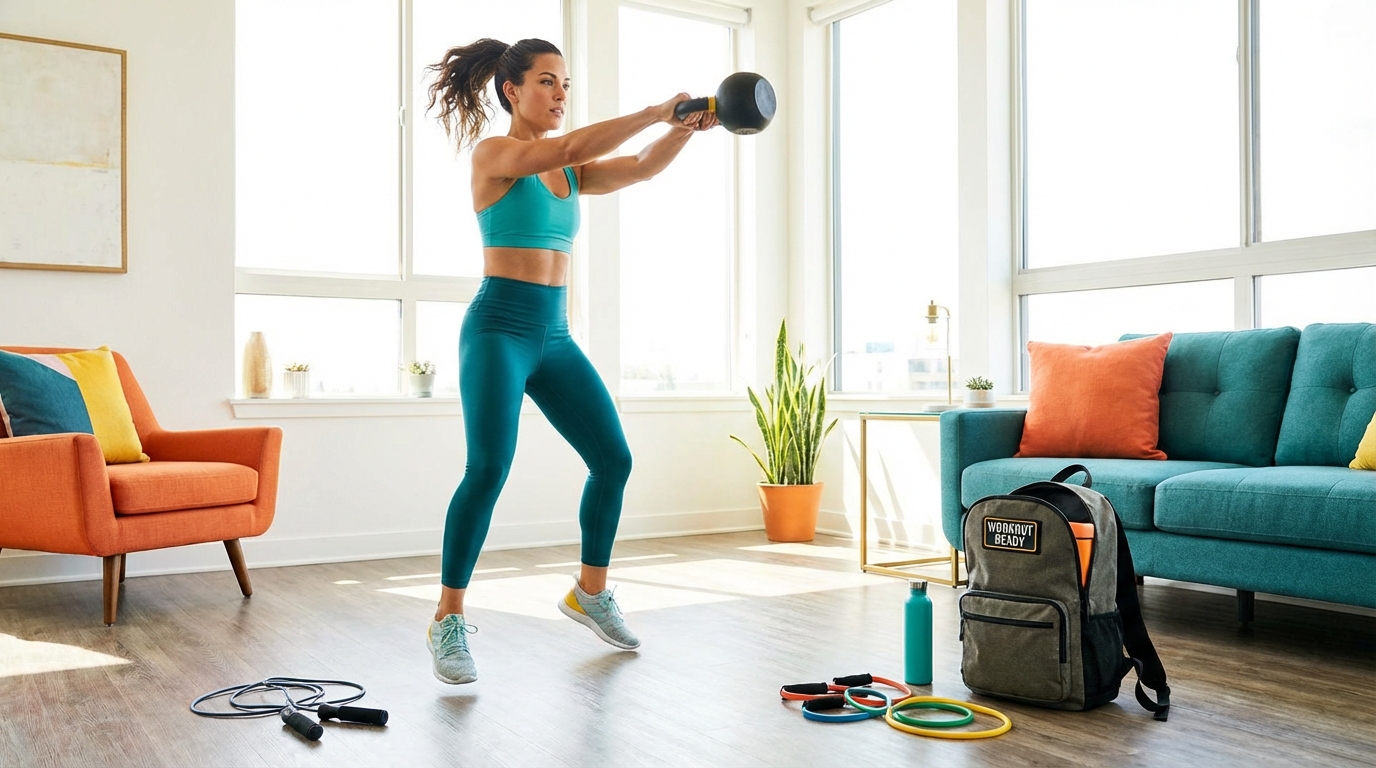
For example, take two exercises, like kettlebell swings and push-ups. Set a timer for 15 minutes. Perform 10 swings followed immediately by 10 push-ups. Repeat this cycle as many times as possible in 15 minutes, keeping rest to an absolute minimum. Record how many total rounds you completed. Next time you do this workout, try to beat your score. This provides a clear metric for progress and ensures maximum intensity in a short window.
14. Gamify Your Fitness
We are wired to respond to rewards, tracking, and competition. If you find motivation lacking for quick daily workouts, turn it into a game. Use a fitness tracker to compete with friends on daily step counts or activity points.
Create a “streak” calendar where you put a big red X on every day you complete your 15-minute workout; your only goal is not to break the chain. Join online challenges focused on consistency. Gamification hacks the brain’s reward centers, making the difficult task of daily exercise feel more engaging and satisfying.
15. Prioritize Mobility and Recovery Work
Not every quick daily workout needs to leave you drenched in sweat and gasping for air. Sometimes, the most productive use of 15 minutes is recovery, especially if you are stressed. Chronic high stress combined with only high-intensity workouts can lead to burnout and injury.
Dedicate some of your daily slots to mobility work, yoga flows, or foam rolling. A 15-minute dedicated stretching routine can undo the damage of sitting at a desk all day, improve your posture, and ensure your body is capable of handling the intense workouts when you do them. Treating recovery as a valid “workout” is a crucial hack for long-term sustainability.
The Profound Benefits of the Quick Workout Approach
Adopting these hacks and committing to quick daily workouts offers benefits that extend far beyond simple time-saving.
Consistency Over Intensity
The most significant benefit is the establishment of consistency. The fitness industry is littered with people who burnt out on 2-hour gym sessions six days a week. By lowering the barrier to entry, you are far more likely to stick with the habit long-term. In the grand scheme of health, doing 20 minutes daily for five years is vastly superior to doing sporadic two-hour sessions for three months.
Metabolic Adaptation
Frequent movement keeps your metabolism humming. By utilizing HIIT and compound movements, even in short bursts, you improve insulin sensitivity and increase your resting metabolic rate. Your body becomes better at utilizing fuel, rather than storing it as fat.
Mental Health and Productivity Boost
Exercise is a potent neurochemical modulator. Even a brisk 15-minute walk or a quick circuit releases endorphins, dopamine, and serotonin. This provides an immediate mood lift, reduces perceived stress levels, and clears brain fog. Many people find that a mid-day micro-workout acts as a reset button, making the afternoon hours significantly more productive.
Improved Health Markers
Studies have consistently shown that accumulating 150 minutes of moderate activity or 75 minutes of vigorous activity per week significantly lowers the risk of chronic diseases like heart disease, type 2 diabetes, and certain cancers. Quick daily workouts, when done consistently, easily meet and exceed these guidelines.
Conclusion: The Power of “Something is Better Than Nothing”
The biggest obstacle to fitness for the busy person is often a rigid mindset about what counts as exercise. We let the perfect be the enemy of the good. The truth is, your body doesn’t care if you are in a fancy gym or your bedroom; it only understands movement and intensity.
By utilizing these fitness hacks, you stop waiting for time to open up and start seizing the moments that already exist. You move from a passive “I wish I had time” to an active “I am making it fit.” The philosophy of quick daily workouts is rooted in the empowering truth that something is always infinitely better than nothing. Five minutes of squats is infinitely better than zero. A 15-minute HIIT session is infinitely better than sitting on the couch thinking about going to the gym for an hour.
Start today. Pick just one of the hacks listed above—perhaps the 5-minute rule or workout stacking while your coffee brews. Don’t overthink it. Just move. The cumulative effect of these small, daily investments in your body will yield massive dividends in your energy, health, and longevity over time.